TECHNICAL ANALYSIS: FOR INDUSTRIAL PROCUREMENT AND QUANTITATIVE BIOCHEMICAL R&D
What Unseen Factors Decide the Structural Integrity and Reliability of Oxytocin Receptor Antagonists?
To the general public, hormones are simply the biological fluids responsible for human emotion. But to a formulation chemist, they are aggressive operational triggers. In scenarios like premature uterine contractility, the body's internal timing mechanism gets disrupted. To fix this, scientists don't use broad muscle relaxants that slow down the whole body. Instead, they use a highly specific group of compounds called Oxytocin Receptor Antagonists (OTAs) to safely hit the pause button. However, securing a stable supply of these raw materials requires understanding the deep chemistry that keeps them working.
Why Is Molecular Specificity the Core Safeguard Against Destructive Off-Target Effects?
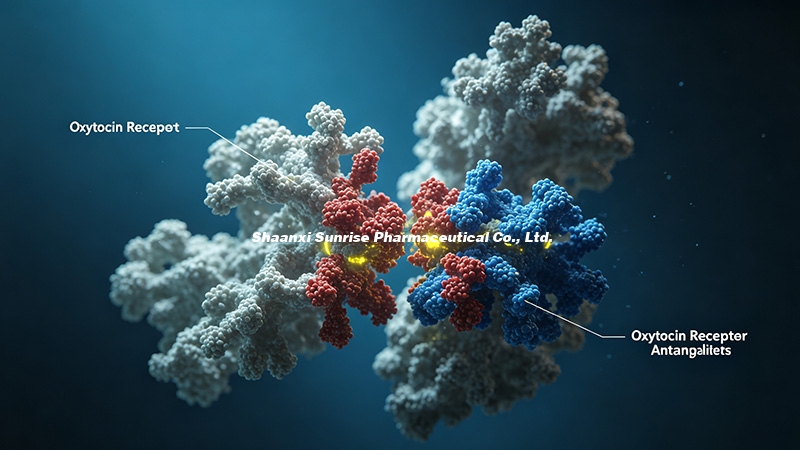
Think of a muscle cell as a highly secure building where commands are delivered through specific entry ports. When natural oxytocin arrives at its designated port, it activates an internal signaling cascade that causes the muscle fibers to tighten violently. An OTA molecule is essentially an expert imposter. It occupies the entry port first, perfectly mimicking the shape required to sit there, but it refuses to deliver any orders. Because it holds the position, the real hormone is effectively locked out.
For a procurement director, the real test of an API is its receptor specificity. Nature created the oxytocin receptor to look almost identical to vasopin receptors, which control blood pressure and fluid balance. If the raw material has a "sloppy" or imperfect shape, it will accidentally block both networks. This mistake can cause severe, unwanted systemic complications in a patient. True safety relies entirely on a molecule with high binding affinity that ignores everything except its exact biological target.
How Do Industrial Synthesis Anomalies Compromise Long-Term Peptide Efficiency?
Most advanced OTAs are built as synthetic peptide chains. Constructing these complex sequences during bulk manufacturing is a massive challenge. Laboratories utilize a step-by-step process called Solid-Phase Peptide Synthesis (SPPS) to lock each amino acid into its exact position. If the chemistry is slightly off during any single step, it triggers a domino effect of errors.
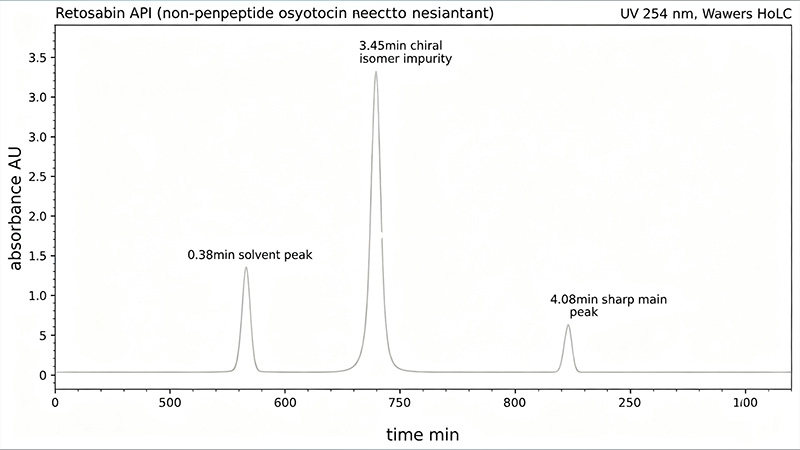
This operational slip creates "deletion sequences"—imperfect chains that are missing vital links. On a basic laboratory printout, these defective variants look almost identical to the genuine product, but they fail completely when introduced to living tissue. To separate the real functional molecules from this inactive debris, the raw material must undergo rigorous High-Performance Liquid Chromatography (HPLC) purification. You are not simply purchasing bulk powder weight; you are purchasing a guarantee of perfect spatial geometry.
What Thermodynamic Measures Prevent Amorphous Powder Degradation Over Time?
Even a batch with an exceptional purity profile can quickly degrade if its physical environment is ignored. Peptide powders are intrinsically hygroscopic, meaning they greedily absorb moisture from the surrounding air. If trace amounts of water molecules are trapped inside the chemical network during the final drying phase, they drive rapid hydrolytic cleaving.
This moisture trap causes the delicate peptide bonds to literally fall apart during storage. To prevent this, the raw material must undergo a carefully calibrated vacuum-drying process to lock the residual moisture content strictly below 2.0%. Combined with rigid cold-chain logistics, this thermodynamic control is the only way to ensure the material hits its required 24-month shelf life without losing its potency.
Technical Procurement Inquiries
Why do some raw peptide batches fail to dissolve clearly during compounding?
This clear dissolution failure is usually caused by physical aggregation. When a peptide is exposed to sudden temperature shifts or extreme mechanical forces during mixing, its structure can fold incorrectly. This misfolding causes the molecules to stick together, forming tiny, insoluble clumps. Preventing this requires gentle, pH-buffered reconstitution without aggressive agitation.
What documentation is mandatory to confirm the absolute identity of a batch?
While an HPLC readout measures the volume of pure material, it cannot verify the exact molecular identity. For absolute validation, the data package must include Mass Spectrometry (MS) analysis. This structural data confirms the precise molecular weight down to the single Dalton, proving that the amino acid sequence is perfectly assembled.
Securing Absolute Precision in Your Raw Supply Chain
Connect directly with technical evaluation channels to review batch chromatograms, validation data, and volume availability.
Request Technical Specifications