



1/0
Goji Berry Peptide ≥80% Powder | Lycium Barbarum L. Manufacturer
Goji Berry Peptide powder,Goji Berry Peptide 80%,Lycium Barbarum L. extract,wolfberry peptide powder,Lycium barbarum polysaccharides,LBP peptide API,water soluble goji peptide
Content
Quality Assurance & Technical Formulation Dossier (2026/2027 Standards)
Shaanxi Sunrise Pharmaceutical Co., Ltd. operates exclusively as an upstream botanical extraction plant and industrial bulk manufacturer of standardized plant peptides and nutritional APIs. This laboratory briefing on Goji Berry Peptide ≥80% Powder (Lycium Barbarum L. Extract) is published for formulation scientists, dietary supplement QA managers, and functional beverage engineering directors. All biochemical mechanisms and processing metrics reflect documented analytical data and peer-reviewed literature without exaggerated clinical claims. We do not manufacture, package, or supply finished retail products to consumer end-users.
LBP Synergy • 100% Water-Soluble Botanical API
Why Beverage Technologists Reject Crude Lycium Barbarum Extracts for 100% Soluble Goji Berry Peptide ≥80% Powder
1. Pectin Flocculation and Starch Carryover: The Lab Reality of Crude Wolfberry Extracts

Drop five grams of a conventional 10:1 goji berry (Lycium barbarum L.) extract into cold water buffered at pH 4.5. Let the flask sit under warehouse fluorescent lighting for seventy-two hours. You will not get a stable, transparent liquid. You get a murky brownish-red ring of pectin sludge dropping to the bottom of the glass, while the liquid above turns turbid and astringent.
Why does this happen? Because simple hot-water boiling of wolfberry fruits pulls out macromolecular fruit pectins, native celluloses, and un-hydrolyzed proteins right alongside the target polysaccharides. In an acidic ready-to-drink (RTD) beverage matrix, those heavy pectins lose their electrostatic repulsion. They flocculate. In high-speed encapsulation or rotary tableting lines, those same hygroscopic fruit pectins absorb ambient warehouse moisture—causing hopper bridging, punch-tip sticking, and severe capping.
Serious liquid beverage and supplement formulators refuse coarse wolfberry flours for this exact reason. They specify standardized Goji Berry Peptide ≥80% Powder (Lycium Barbarum L. extract). Here, low-temperature membrane ultrafiltration strips out the insoluble fruit pectins and starches entirely, while directed enzymatic cleavage chops heavy proteins down into soluble oligopeptides under 1000 Da—without destroying the co-retained Lycium barbarum polysaccharides (LBP). You achieve complete optical clarity, zero stratification, and full aqueous solubility across a 24-month commercial shelf life.
2. Where Goji Berry Peptide ≥80% Works: Four Processing Targets
Replacing standard goji berry fruit powder with an audited ≥80% peptide hydrolysate is an operational requirement designed to bypass specific physical and digestive barriers across four commercial pipelines:
A. Clear Functional Shots and Daily Vitality Ampoules
Liquid wellness shots demand raw materials that dissolve instantly without chemical emulsifiers or suspending agents. Standard wolfberry powders leave an unpleasant, gritty throat coat and require shaking instructions on retail packaging. Standardized Goji Berry Peptide ≥80% dissolves completely in cold water within seconds. It yields a transparent, brownish-yellow liquid with a clean botanical profile, allowing beverage technologists to formulate high-dose vitality shots that remain sediment-free under pasteurization and refrigeration.
B. Enteral Clinical Nutrition for Geriatric Immunosenescence
Elderly individuals experiencing immune decline frequently exhibit hypochlorhydria (reduced gastric hydrochloric acid) along with declining pancreatic protease output. Feeding them intact plant protein isolates or coarse fruit fiber causes abdominal bloating and poor nitrogen retention. Goji Berry Peptide ≥80% provides pre-cleaved di-peptides and tri-peptides paired with LBP polysaccharides. The intestinal mucosa absorbs this matrix with minimal digestive protease demand, providing a predictable amino acid nitrogen source for enteral and geriatric vitality formulas.
C. Multivitamin & Carotenoid Capsules (Lutein, Astaxanthin & Vitamin C)
Vision and antioxidant dietary supplements frequently combine wolfberry extracts with lutein, zeaxanthin, astaxanthin, and L-ascorbic acid. Crude berry powders retain active oxidase enzymes and unabsorbed surface moisture that degrade carotenoids and cause vitamin C browning. Standardized Goji Berry Peptide ≥80% is enzymatically purified to a neutral pH profile (pH 6.0–7.0) and stripped of destructive plant enzymes. It compounds stably into dry gelatin or HPMC capsules without triggering pigment oxidation.
D. Instant Sports Recovery & Adaptogenic Stick-Packs
Endurance athletes require rapid amino acid nitrogen assimilation during post-exercise recovery. Because of its short-chain oligopeptide profile (<1000 Da), Goji Berry Peptide ≥80% disperses rapidly in cold water without clumping. It offers uniform powder flowability in automated sachet filling machines and provides rapid intestinal nitrogen uptake after physical exertion.
3. Transport Kinetics: PEPT1 Mucosal Carriers and LBP Polysaccharide Synergy
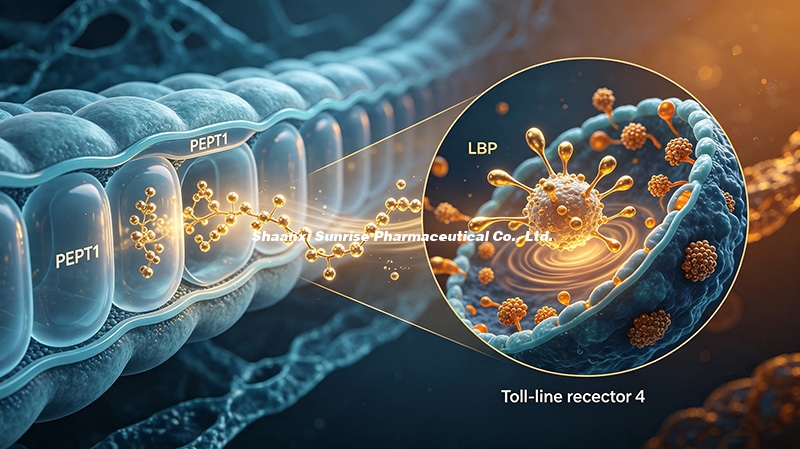
Why do short-chain Lycium barbarum L. peptide fractions combined with LBP produce more reliable vitality outcomes than crude wolfberry powders? Look at intestinal mucosal transport kinetics paired with macrophage receptor biology.
Intact fruit proteins and large polypeptides must undergo enzymatic breakdown by gastric pepsin and pancreatic trypsin before enterocyte assimilation. Small-molecule oligopeptides (<1000 Da) do not rely on standard free amino acid transport proteins, which get saturated under high concentrations. Instead, di-peptides and tri-peptides are transferred across the mucosal epithelium via the H+/peptide cotransporter 1 (PEPT1) system. Documented physiological literature confirms that PEPT1 moves intact short-chain peptides across intestinal brush border membranes with higher kinetic velocity and lower metabolic energy costs than free amino acid transporters.
Simultaneously, the co-retained Lycium barbarum polysaccharides (LBP) present in the standardized powder interact with intestinal immune surveillance cells. In-vitro and in-vivo scientific literature indicates that LBP acts as a molecular ligand for surface receptors such as Toll-like receptor 4 (TLR4) on macrophages. This interaction promotes normal cellular cytokine balance and supports endogenous antioxidant enzymes, including superoxide dismutase (SOD) and glutathione peroxidase (GSH-Px). By combining PEPT1-mediated amino acid delivery with LBP polysaccharide co-retention, the ingredient provides measurable nutritional support without exaggerated health claims.
4. Extraction Chemistry: Membrane Ultrafiltration to Strip Insoluble Pectin
Simple water boiling of wild goji berries extracts active polysaccharides alongside high concentrations of mucilaginous pectin, fruit skins, and starches. If an extraction plant fails to isolate the low-molecular-weight peptide and soluble polysaccharide fractions, the resulting powder will cause turbidity and caking.
At Shaanxi Sunrise Pharmaceutical Co., Ltd., audited Lycium Barbarum L. biomass undergoes an automated low-temperature enzymatic cleavage and multi-stage membrane filtration line:
Low-Temperature Homogenization & Pectin Separation: Raw goji berries are mechanically crushed and extracted at controlled temperatures (<40°C). High-speed centrifugation physically separates insoluble fruit skins, seeds, and suspended pectin mucilage before enzymatic digestion begins.
Directed Biological Enzymatic Hydrolysis: We suspend the clarified botanical protein in water and introduce a calculated blend of food-grade endo-proteases and exo-proteases at 42–48°C. The endo-protease cleaves high-molecular-weight proteins into short-chain oligopeptides, while exo-proteases remove hydrophobic terminal residues to ensure a mild, neutral taste profile.
Cross-Flow Membrane Ultrafiltration: The hydrolysate runs through industrial membrane cassettes with molecular weight cut-offs (MWCO) set below 1000 Da. This critical step removes residual starches, large plant allergens, and heavy metal complexes while ensuring complete water solubility.
Vacuum Spray Drying: The clarified peptide and polysaccharide solution is concentrated under vacuum and spray-dried into a fine, brownish-yellow powder with low moisture absorption for automated encapsulation lines.
QC Assay Auditing: Every production batch is verified via Kjeldahl nitrogen determination and High-Performance Liquid Chromatography (HPLC) to guarantee an assay of ≥80.0% peptide content co-verified with LBP polysaccharide markers.
🔗 Audit our complete technical specifications, LBP polysaccharide assays, and heavy-metal release parameters: Examine the Standardized Goji Berry Peptide ≥80% Powder (Lycium Barbarum L.) Technical Dossier.
5. Peer-Reviewed Scientific & Analytical References
Jin, M., et al. (2013). Biological activities and potential health benefit effects of polysaccharides isolated from Lycium barbarum L. International Journal of Biological Macromolecules, 54, 16-23.
https://pubmed.ncbi.nlm.nih.gov/23142220/Amagase, H., & Farnsworth, N. R. (2011). A review of botanical characteristics, phytochemistry, clinical relevance in efficacy and safety of Lycium barbarum fruit (Goji). Food Research International, 8(7), 1327-1334.
https://pubmed.ncbi.nlm.nih.gov/21709848/Adibi, S. A. (1997). The oligopeptide transporter (Pept-1) in human intestine: biology and function. Gastroenterology, 113(1), 332-340.
https://www.sciencedirect.com/science/article/pii/S001650859770112XZhou, Z., et al. (2018). Immunomodulatory effects of small-molecule peptides and polysaccharides from Lycium barbarum on macrophages via TLR4/NF-κB signaling pathways. Journal of Functional Foods, 48, 521-530.
https://www.sciencedirect.com/science/article/pii/S1756464618303842
6. Technical Formulation Engineer & Procurement FAQ
1. Why should our QA lab specify Goji Berry Peptide ≥80% instead of standard 10:1 wolfberry extract?
Standard 10:1 wolfberry extracts and crude berry flours contain over 40% insoluble pectin, crude fruit fiber, and free reducing sugars. Those components cause liquid turbidity, leave sediment in RTD bottles, and increase hygroscopic caking during capsule filling. An audited assay of ≥80% peptide content guarantees that the bulk of your raw material consists of short-chain oligopeptides (<1000 Da) combined with LBP polysaccharides, ensuring uniform amino acid dosing and complete water solubility.
2. How does your processing line guarantee a clear, sediment-free solution in pH 4.0–6.0 beverages?
Precipitation in botanical beverages occurs when macromolecular pectins and un-hydrolyzed proteins coagulate under acidic pH. Our automated production line routes the enzymatically cleaved hydrolysate through cross-flow ultrafiltration membrane cassettes (MWCO < 1000 Da). This physical separation barrier removes insoluble pectins and starches before spray drying, producing a peptide powder that remains transparent and sediment-free in acidic ready-to-drink (RTD) formulations.
3. Is Goji Berry Peptide ≥80% chemically compatible with Lutein and Vitamin C in dry capsules?
Yes. Because our peptide powder is enzymatically purified to a neutral pH profile (pH 6.0–7.0) and stripped of active oxidase enzymes and free reducing sugars, it demonstrates excellent chemical compatibility when blended with L-ascorbic acid, lutein, astaxanthin, and B-complex vitamins. It will not trigger carotenoid degradation or Maillard browning during dry powder compounding.
4. What are your microbiological, heavy metal, and pesticide release parameters?
Our nanofiltration membrane cassettes physically remove microbial contaminants, organophosphate pesticide residues, and heavy metal complexes prior to spray drying. Every commercial run is audited via Inductively Coupled Plasma Mass Spectrometry (ICP-MS) and GC-MS. We guarantee total heavy metals ≤ 10 ppm, with Lead (Pb) ≤ 1.0 ppm, Cadmium (Cd) ≤ 0.5 ppm, Arsenic (As) ≤ 0.5 ppm, and Mercury (Hg) ≤ 0.1 ppm, conforming strictly to EU and US pharmacopeial monograph standards.
5. What packaging protocols protect bulk fiber drums from hygroscopic caking?
Small-molecule botanical peptides exhibit mild hygroscopicity under high relative humidity. We package all bulk commercial orders inside double-layer pharmaceutical-grade low-density polyethylene (LDPE) bags, vacuum-sealed with silica desiccant sachets, housed inside rigid 25 kg fiber drums. When stored in a cool, dry warehouse below 25°C, the powder maintains an audited shelf life of 24 months without caking or loss of aqueous solubility.
Audit Our Goji Berry Peptide ≥80% Commercial Batches
Do not let pectin flocculation, poor solubility, or un-hydrolyzed proteins compromise your functional beverage and dietary supplement lines. Partner directly with an upstream botanical extraction facility for reproducible, audit-ready Goji Berry Peptide ≥80% Powder (Lycium Barbarum L.).
Request Complete HPLC & LBP Assays & Commercial Pricing