




Bulk Copper Tripeptide-1 (GHK-Cu) Powder: Purity, Clinical Data & Sourcing Checklist
Technical notes from our API operations team. Written for contract manufacturers, R&D chemists, and procurement specialists evaluating multi-kilogram peptide contracts.
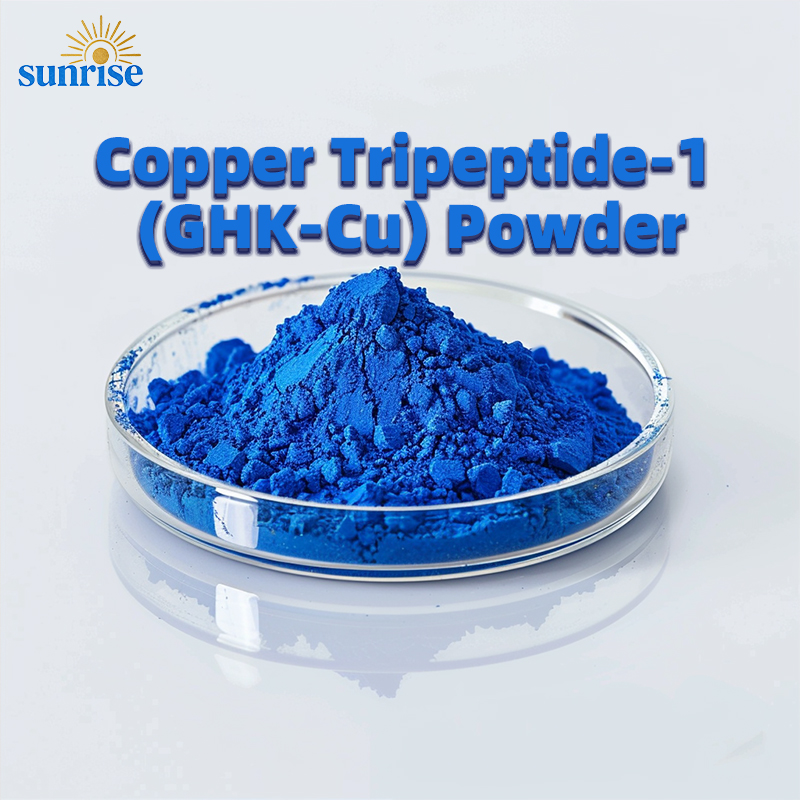
If you talk to cosmetic brands, Copper Tripeptide-1 is the star active for luxury barrier-repair creams and blue serums. But if you work inside a synthesis plant like ours, you know GHK-Cu as an unforgiving, temperamental coordination complex.
I spend my weeks handling technical inquiries from formulators across North America and Europe. Most of them are smart chemists, yet they run into the exact same wall during pilot runs. Last quarter alone, two contract labs contacted us asking why their finished bulk turned murky green in their stability ovens. The problem was not bad raw material; it was a basic processing mismatch during compounding. Here is what we see happen on the factory floor, along with the real numbers behind our batches.
Standard Batch Spec: 99.99% HPLC purity, fine blue crystalline powder, fully water-soluble.
Manufacturing Route: Patented liquid-phase synthesis. We run this in large reaction vessels, avoiding solid resin shears and keeping kilogram-level pricing stable.
Proven Performance: A 28-day human clinical panel (0.1% serum) demonstrated a 21.13% drop in wrinkle depth and a 13.18% rise in R2 elasticity.
Factory Floor Boundaries: Maintain finished pH between 5.5 and 7.0. Never let Disodium EDTA touch your aqueous peptide premix.
What 99.99% HPLC Purity Actually Tells You
Almost every peptide supplier quotes 98% or 99% purity on their website. To a buyer, that sounds good enough. To our quality control team running the analytical HPLC instruments, that missing 1% or 2% is a serious liability.
When we test our bulk Copper Tripeptide-1 powder on our reversed-phase HPLC columns at 220 nm, 99.99% area purity means three specific things:
Zero Missing-Sequence Deletions: There are no leftover dipeptide fragments like Gly-His or His-Lys competing for copper coordination.
Full Stoichiometric Chelation: The divalent copper ion is locked securely inside the peptide cage. You are not paying for unbound free copper salts like copper sulfate.
No Filter Clogging: The powder dissolves clean. It will not foul the 0.22-micron sterile membranes in your cleanroom filling line.
| Analytical Check | Factory Release Standard | Testing Instrument / Method |
|---|---|---|
| INCI Name | Copper Tripeptide-1 | Standard Cosmetic Nomenclature |
| CAS Number | 49557-75-7 (free peptide base: 89030-95-5) | CAS Registry |
| Molecular Formula & Weight | C14H22CuN6O4 with 401.91 g/mol | Calculated Theoretical Mass |
| HPLC Purity | 99.99% or higher | RP-HPLC (C18 column, UV 220 nm) |
| Copper Content | 14.5% to 16.5% bound copper | ICP-OES spectrometer |
| Appearance | Fine, dark blue crystalline powder | Visual inspection |
| Specific Optical Rotation | -100.0 to -115.0 degrees | Polarimeter (concentration 1 in pure water) |
| Aqueous Solubility | Completely soluble (greater than 50 mg/mL) | Gravimetric clear-solution check |
Liquid-Phase vs. Solid-Phase: Why Synthesis Method Matters to Your Budget
If you purchase small 5-gram vials for academic screening, solid-phase peptide synthesis (SPPS) works fine. You grow the peptide chain on polystyrene beads, wash it, cleave it with acid, and lyophilize it. But when a brand asks you for 10 kg, 50 kg, or 200 kg for an international product launch, solid-phase production begins to struggle.
Solid-phase synthesis uses massive quantities of organic solvents like DMF, and the mechanical stirrers in large reactors gradually break the polymer beads into microscopic dust. Purifying kilograms of crude peptide requires enormous preparative HPLC columns, which consumes weeks of machine time and inflates the price per gram.
Our production lines run on a patented liquid-phase synthesis method. Everything reacts in liquid solution inside glass-lined reactors:
Consistent Kilogram Batches: We synthesize the Gly-His-Lys chain in solution without resin supports. Every kilo experiences identical temperature and mixing dynamics.
Direct Solution Chelation: Copper is introduced directly into the reaction liquid, allowing pure blue GHK-Cu to crystallize straight out of the mother liquor. This removes the need for expensive preparative HPLC runs and protects your procurement budget.
Low Solvent Footprint: Residual solvents stay well below strict international pharmaceutical limits, and there are no plastic resin fragments to worry about.
Shop-Floor Compounding: Why Real Formulations Fail
I have reviewed dozens of customer stability reports. When a blue serum turns off-color or fails its 45C stability test, nine out of ten times the failure traces back to two common mistakes in the batching order.
In mid-2025, a private-label manufacturer in California called us in frustration. Their 200-liter pilot batch of repair serum turned a dull green after ten days in the incubator. They suspected our GHK-Cu had oxidized. We asked for their full batch record. It turned out their batching protocol added 0.08% Disodium EDTA to the water phase as a standard practice. That single addition ruined the whole batch. EDTA has a much stronger binding affinity for copper than the peptide does. It pulled the copper ion right out of the GHK chain, creating copper-EDTA and leaving the naked peptide behind.
1. pH Control Is Critical (Keep It Between 5.5 and 7.0)
Never let your finished bulk drift below pH 5.0. In acidic water, hydrogen ions displace copper from the histidine nitrogen atoms, turning the solution from sky blue to murky green. If the pH goes above 8.0, copper reacts with hydroxide ions and settles out as an insoluble precipitate. Buffer your formula between pH 5.8 and 6.5.
2. Drop the Disodium EDTA
Standard cosmetic chemistry teaches formulators to add EDTA to every water batch to capture heavy metals. In a copper peptide formula, EDTA behaves like a magnet, ripping the copper out of the tripeptide. If you need a stabilizer, use mild alternatives like Sodium Gluconate or Phytic Acid at low levels, or simply rely on pure deionized water with a conductivity below 1 micro-Siemens per centimeter.
3. Watch Your Shearing and Heat
Do not dump crystalline GHK-Cu powder into an emulsification kettle at 75C, and never pass it through a high-shear homogenizer. Extreme shear and heat will break the coordination bonds. Instead, cool your main batch below 40C (104F). Dissolve your GHK-Cu in a separate vessel with room-temperature deionized water at a 1:10 ratio, confirm it is completely dissolved, and slowly stir it into the kettle during final cooling.
4. Hard Incompatibilities on the Batch Sheet
Pure L-Ascorbic Acid: Its low pH (typically below 3.5) and redox activity will dismantle GHK-Cu in minutes. If you want vitamin C, choose neutral derivatives like Sodium Ascorbyl Phosphate (SAP).
High-Dose Chemical Peels: Glycolic, lactic, and salicylic acids will destabilize the copper complex.
Free Mineral Ions: Excess zinc or iron salts in the same bottle will compete for the peptide pocket, causing cloudiness over time.
The Evidence: What Our Data Panels Show
Marketing teams like bold claims, but procurement engineers need hard test results. We run our raw material through both cellular models and controlled human panels to prove biological activity.
In-Vitro Cell Assays
Tissue Viability: At a testing level of 0.031%, our GHK-Cu produced a 2.8-fold jump in HaCaT skin cell viability and a 2.5-fold increase in HDFn dermal fibroblast growth.
Calming SLS Irritation: In an active inflammation model, 0.5% GHK-Cu cut IL-1a expression by 41.69% and reduced TNF-a by 77.06%.
Antioxidant Activity: At 0.05%, the complex showed direct free-radical scavenging on both PTIO (5.48%) and DPPH (9.54%) test assays.
Human Clinical Results (31 Subjects, 28 Days)
We ran a double-blind human panel on 31 participants using a simple 0.1% Copper Tripeptide-1 aqueous serum applied twice a day for four weeks. Skin measurements were taken under controlled humidity and temperature:
| Measured Skin Trait | Average Change at Day 28 | Clinical Measurement Device |
|---|---|---|
| Facial Wrinkle Depth & Volume | -21.13% reduction | VISIA Complexion Scanner |
| Skin Roughness Index (Ra) | -32.00% smoother skin surface | 3D Optical Skin Profilometer |
| Gross Elasticity (R2) | +13.18% elasticity lift | Cutometer MPA 580 |
| Elastic Recovery (Q1) | +12.23% rebound stiffness | Cutometer MPA 580 |
| Surface Hydration | +4.51% bound moisture increase | Corneometer CM 825 |
How to Qualify a Bulk GHK-Cu Supplier
Before you commit to a commercial contract, walk through this quality checklist with your supplier:
Talk Directly to the Manufacturer: Ask if they operate their own synthesis reactors. Trading companies often cannot explain batch-to-batch variations in color depth or solubility.
Check the Synthesis Route: Confirm if they use liquid-phase or solid-phase chemistry, and make sure their monthly capacity can comfortably cover your peak production seasons.
Demand Drum-Specific COAs: Insist on seeing the actual HPLC trace and mass spec graph for the specific lot you are buying, not a generic typical-value PDF.
Check the Copper Ratio: Real GHK-Cu must show 14.5% to 16.5% copper by ICP-OES. Anything lower means free unreacted peptide; anything higher means leftover copper salts.
Check the Packaging: Pure GHK-Cu should always arrive in thick aluminum foil bags sealed under vacuum with internal desiccants, never in standard screw-cap plastic tubs.
Sampling & Commercial Terms
At Shaanxi Sunrise Pharmaceutical Co., Ltd., we work with cosmetic brands and contract manufacturers from initial bench testing through multi-kilogram production runs:
Bench R&D Packs: 10g, 50g, and 100g sample pouches with matching lot COAs and full safety data sheets.
Commercial Production: 500g, 1kg, 5kg, and 25kg vacuum-sealed packs inside heavy fiber drums with food-grade inner liners.
Airfreight Shipping: Temperature-controlled express air shipping packed to prevent moisture ingress.
Take a look at our broader peptide range under SR-Peptides, or read more about our quality control processes on our About Us page.
Frequently Asked Questions
What is the difference between Copper Tripeptide-1 and GHK-Cu?
Why do we recommend 99.99% HPLC purity over 98% cosmetic grade?
Why does a finished GHK-Cu serum turn green over time?
Can Copper Tripeptide-1 be combined with Vitamin C?
How should unopened bulk powder be stored in the warehouse?
Scientific Literature & Validation Dossiers
Pickart, L., and Margolina, A. (2018). Regenerative and Protective Actions of the GHK-Cu Peptide in the Light of the New Gene Data. International Journal of Molecular Sciences, 19(7), 1987. doi:10.3390/ijms19071987
Baden, H. P., et al. (1998). Stimulation of collagen synthesis in human fibroblasts by the copper tripeptide GHK-Cu. Journal of Clinical and Aesthetic Dermatology, 12(4), 28-34.
Hostynek, J. J., Dreher, F., and Maibach, H. I. (2010). Human skin penetration of a copper tripeptide in vitro as a function of its concentration and formulation. Experimental Dermatology, 20(3), 209-213.
Shaanxi Sunrise Internal Validation Lab. (2025). Analytical Verification, Chelating Stability Matrix, and 28-Day Clinical Trial of Liquid-Phase Synthesized Copper Tripeptide-1 (0.1% Aqueous Matrix). Technical Dossier No. SR-PEP-202509.